When a Big Vision Finally Has the Right Website Platform
Thousands of families are searching for classical education — and coming up empty. That was the problem Humanitas Institute set out to solve. But …
A Gap Too Big to Ignore Thousands of families are searching for classical education — and coming up empty. That was the problem Humanitas Institute set out to solve. But having a big vision is only the beginning; without the right digital foundation, even the best ideas stall.
In this post, we're sharing how the Ministry Impact Platform turned Humanitas's idea — a resource that, in their own words, "does not exist in any way, shape, or form" — into a world-class, living platform serving families nationwide.
What the Ministry Impact Platform Made Possible
Classical education has never lacked passion or purpose. What it lacked was a digital experience worthy of the mission. Together, Five Q and Humanitas changed that — and the results speak for themselves
1. Over 3,200 schools and homeschool co-ops are now listed in the Humanitas School Finder — a searchable, filterable directory that did not previously exist at this scale.
2. The School Finder goes beyond a basic directory listing by giving every school profile the details families need to make a confident decision — including grades served, school type, enrollment size, physical address with directions, a link to the school's website, and a direct "Contact School" button for one-tap outreach.
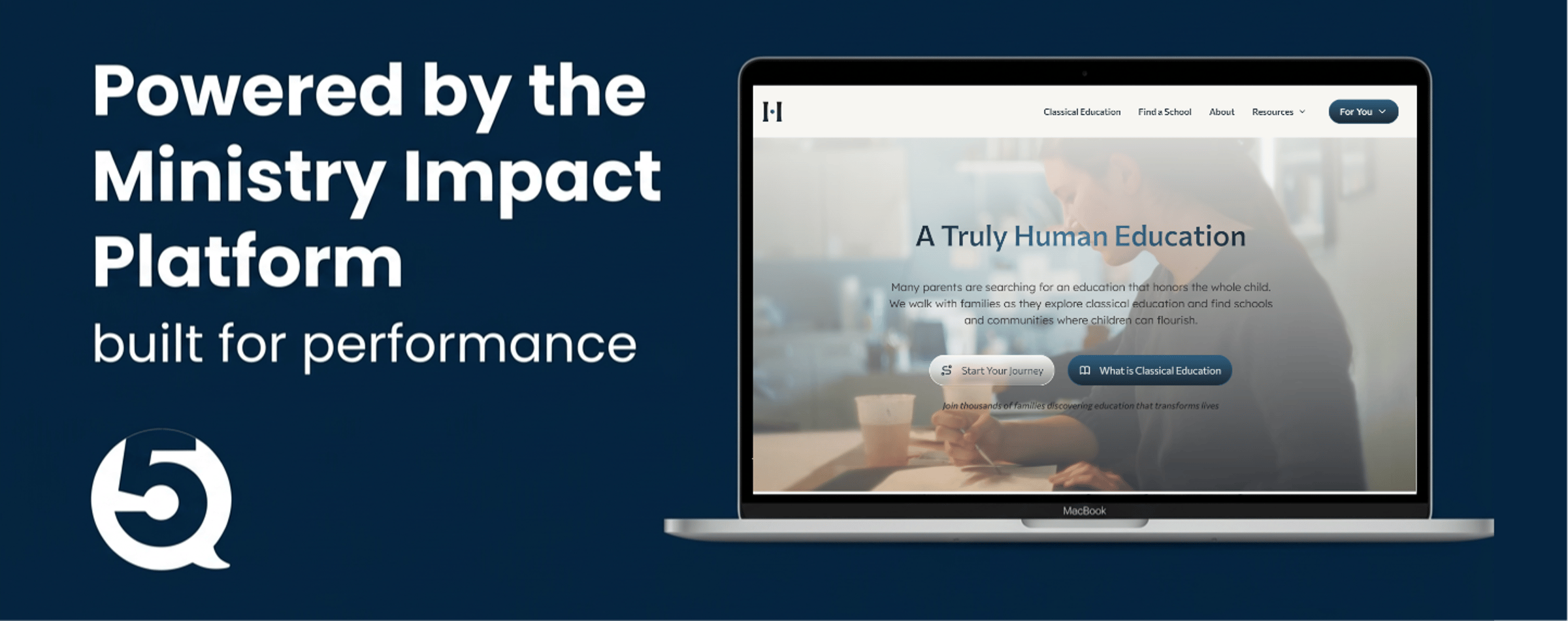
3. Personalized user experience journeys are built into the platform, meaning visitors receive content and resources tailored to their specific role — whether they are a searching family, an educator, or a school administrator.
4. Legacy content fragmentation was resolved through the Ministry Impact Platform, which consolidated years of articles and organized them through tags and series — dramatically improving content discoverability.
The Real Gap Between Vision and Impact This case study matters to every ministry leader with a big vision and a limited runway to bring it to life.
Here is what the Humanitas story makes clear: the gap between a great idea and real ministry impact is almost always a technology and strategy problem, not a mission problem. Humanitas had the right mission. What they needed was a platform built to match it — one that could handle intelligent search, personalized user journeys, and organized content at scale.
Christopher Perrin, the creative force behind Humanitas, described the vision before the build:
"...families that don't know yet that they're interested in classical Christian education...to be able to search...and not only search for schools, but these micro schools, or these pods, or these homeschool co-ops...would be a remarkable resource that does not exist in any way, shape, or form right now." — Christopher Perrin
What the Ministry Impact Platform delivered — intelligent filtering, personalized experiences, and organized content — are not luxury features. For a ministry trying to reach families at the very beginning of a faith-driven educational journey, these are the table stakes for trust. If your digital experience does not meet people where they are, with what they need, in a way that feels built for them, they will leave and never return.
"I think the special brilliance that we have is not just the database. It's this UI and UX. I think we're going to be in a very good place." — Christopher Perrin
The encouraging news: you do not have to build this from scratch. That is exactly what the Ministry Impact Platform was designed to do — give ministries a proven foundation so they can focus on mission, not infrastructure.
Your Next Steps
The Humanitas story is proof that the right digital foundation can turn a vision into reality. But knowing where to start is often the hardest part. Here are four specific steps you can take right now to begin closing the gap between where your ministry is and where it needs to be.
1. Audit your current digital experience against your top-of-funnel audience. Visit your own website as if you are a first-time visitor who barely knows they need what you offer. Is the experience intuitive? Can they find what they need quickly? Make a list of every place where a new visitor could get lost or give up.
2. Identify if you have a content fragmentation problem. If your website has grown over multiple years with different teams contributing, there is almost certainly a content organization issue beneath the surface. Catalog your key content categories and ask: Can a first-time user find what they need within two clicks? If not, prioritize a content architecture review.
3. Map your user journeys by role. Rather than building one website experience for everyone, identify the two or three distinct audiences your ministry serves and define what each one needs when they first arrive. This is the first step toward personalization — and the Ministry Impact Platform can help you build it.
4. Schedule a conversation with the Five Q team to explore whether the Ministry Impact Platform is the right foundation for where your ministry is going.
Your Vision Deserves the Right Foundation
You have a vision. The question is whether your digital foundation is strong enough to carry it forward.
What Humanitas Institute proved is that the right platform — paired with the right strategic partner — can take an idea from "this does not exist anywhere" to a world-class tool serving thousands of families. That is not just a technology win. That is mission impact at scale.
You are not alone in trying to close the gap between your vision and your digital reality. That is exactly the work we do every day alongside ministries like yours. Together, we can build something that lasts.
Schedule a demo to see what the Ministry Impact Platform could do for your ministry.