How Global Media Outreach Uses AI Without Losing Its Soul
The Question Every Ministry Leader Is Asking
Most ministry leaders know AI is no longer a future consideration — it's here, and it's reshaping how organizations reach people at scale. But for many, the harder question isn't whether to adopt AI; it's how to do it in a way that stays true to your mission, protects your people, and actually moves the needle on discipleship.
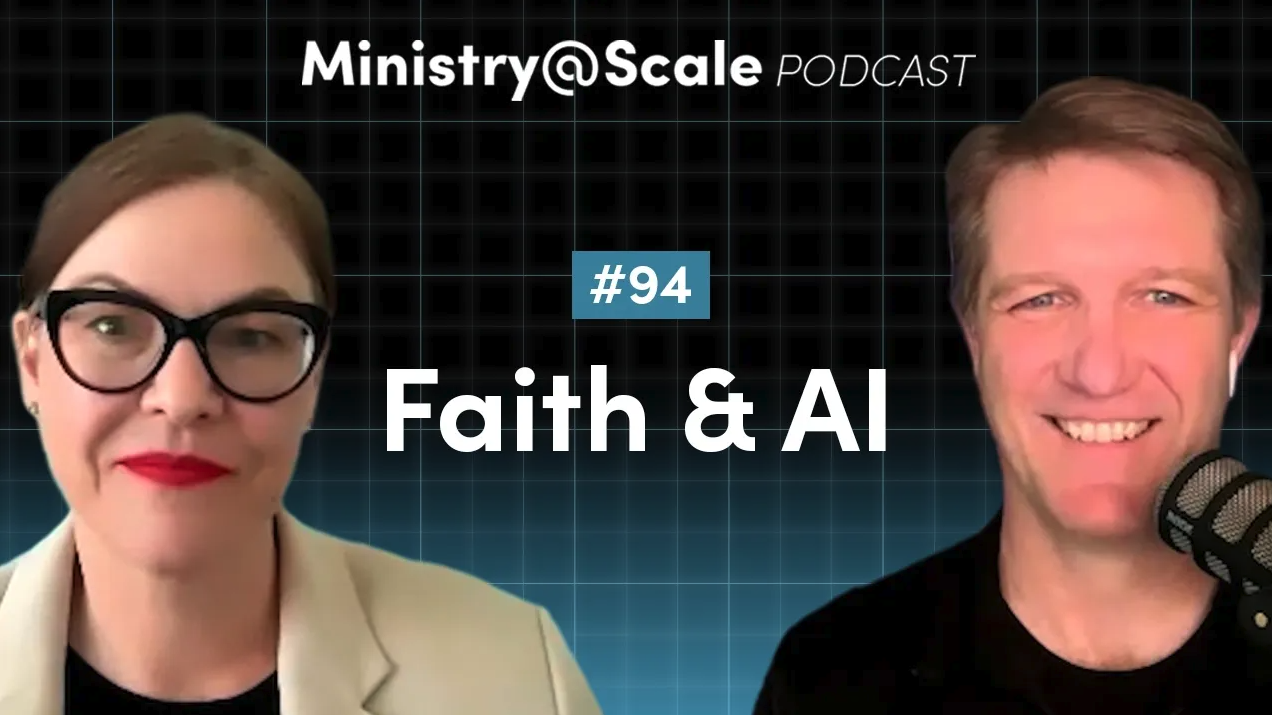
In this episode of the Ministry at Scale Podcast, host Chad Williams sits down with Yvonne Carlson — CTO of Global Media Outreach (GMO) and co-director of the Missional AI Global Summit — to walk through exactly how GMO built and deployed a responsible AI strategy from the ground up. If your ministry is wrestling with where to start with AI, this conversation is the roadmap you've been looking for.
What GMO Got Right — And What You Can Learn From It
The following insights are drawn directly from Yvonne Carlson's conversation on the Ministry at Scale podcast, Faith and AI With Yvonne Carlson from Global Media Outreach, and her 2026 Digital Ministry Conference session, AI with Integrity: GMO's Journey to Responsible Implementation.
1. Start with Vision and Mission — Not Technology. According to Yvonne, GMO's first step was not choosing an AI tool. It was asking: What is our mission, and how can AI serve it? They developed an AI task force and a formal white paper to guide their approach before any technical implementation began. For ministry leaders, this is a critical distinction — AI strategy must flow from mission, not the other way around.
2. GMO's Human-First AI Policy Has Three Foundational Commitments. Yvonne outlined that GMO built their AI framework around three core pillars: biblical alignment, transparency, and keeping a "human in the loop." This means AI is deployed to enhance human ministry — not replace it. Every AI-assisted interaction still has a person accountable for the outcome.
3. AI Is Freeing Missionaries for Deeper Discipleship. Rather than adding to staff workloads, GMO has deployed AI in practical areas, including data analysis, finance, grant writing, and personalizing digital outreach. The result: missionaries spend less time on administrative tasks and more time on the relational work of discipleship that only humans can do.
4. Free, Public AI Tools Carry Real Ministry Risk. Yvonne was direct about the security risks many ministries are overlooking. Using free, public AI environments can expose sensitive data — including personally identifiable information (PII) from the people your ministry serves. She emphasized the importance of using secure, private AI environments, especially when handling donor data, counseling records, or personal prayer requests.
Why This Matters for Your Ministry Right Now
This conversation isn't theoretical — it's a proven case study from a global ministry that reaches millions of people digitally. And it answers the question ministry leaders are quietly asking: "Can we use AI responsibly, and will it actually help us do more with what we have?"
Strategic Clarity
GMO's model shows that AI doesn't require a massive budget or a large tech team to be effective — it requires intentionality. When you anchor your AI strategy to your mission first, you make better decisions about where to invest, and you can demonstrate to your board and donors that technology is being stewarded well.
Operational Alignment and Efficiency
GMO's framework — biblical alignment, transparency, human in the loop — gives your team a concrete governance structure to work from. It also offers a practical warning: the free AI tool your team is already using may not be the safe one.
The goal of AI in ministry is not efficiency for its own sake. It's freeing your people to do the irreplaceable work of walking with someone toward faith.
Three Steps to Get Started Today
1. Draft a one-page AI mission statement for your organization before adopting any new tools. Use Yvonne's framework as a starting point: What is your ministry's mission? How should AI serve that mission? What are your non-negotiables (biblical alignment, transparency, human oversight)? Get leadership aligned on these questions before evaluating platforms.
2. Audit the AI tools your team is currently using. Make a list of every AI tool in use across your organization — by any department or staff member. For each one, ask: Is this a secure, private environment? Could sensitive data (donor info, counseling notes, personal prayer requests) be exposed? If you are using free, public tools for sensitive work, begin evaluating private alternatives immediately.
3. Identify one high-volume, low-discipleship task where AI could free up your team. Look at where your staff spends significant time on tasks like data entry, report writing, or content formatting. Start there. GMO saw results in data analysis, finance, and grant writing. One well-placed AI integration can reclaim hours each week for the relational ministry work that only people can do.
You Don't Have to Figure This Out Alone
Yvonne Carlson's journey with Global Media Outreach is a powerful reminder that the ministries that will thrive in the AI era aren't the ones who move fastest — they're the ones who move wisely. When technology is anchored to mission, governed with integrity, and deployed in service of people rather than in place of them, it becomes one of the most powerful tools in the Kingdom.
We're all navigating this together, and conversations like this one are exactly why the Ministry at Scale community exists.
Listen to the full episode with Yvonne Carlson on the Ministry at Scale Podcast.