Build Real Ministry Tools With AI
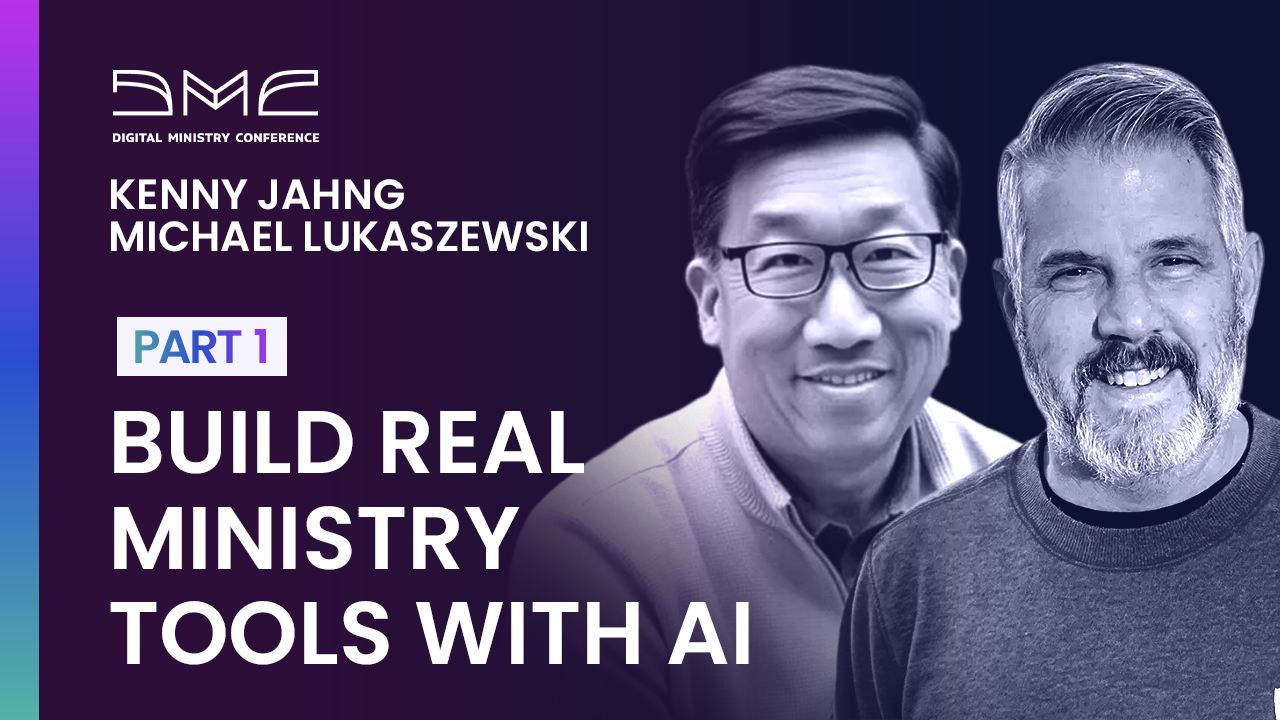
For years, ministry leaders have had ideas that never made it off a napkin — not because the ideas weren't good, but because building anything digital felt out of reach without a developer, a budget, and weeks of back-and-forth.
What if that barrier no longer existed?
At the 2026 Digital Ministry Conference, two AI leaders (Kenny Jahng and Michael Lukaszewski) took a room full of non-technical ministry leaders through a live workshop on vibe coding — and by the end, attendees were building real, functional tools for their organizations. In this post, we're pulling the key lessons from that session, so your team can start multiplying your ministry's digital impact without waiting on anyone else.
What the Room Learned (And Built) at DMC 2026
Here are the five things that stood out most from the session — and why they matter for your ministry.
1. Vibe coding is describing what you want — not writing code. Kenny and Michael defined vibe coding as simply talking to an AI-powered tool to build functional digital products. As one put it: "If you can use ChatGPT, you can vibe code something." The skill isn't technical — it's the ability to clearly describe what you want, who will use it, and what success looks like. They framed this as a delegation skill: the same clarity you need to manage a strong team member is the clarity you need to get great results from a vibe coding tool.
2. A simple framework makes all the difference. The workshop introduced a four-part framework for building anything with vibe coding, using the acronym V.I.B.E.:
V — Vision: Get crystal clear on the problem you're solving, who will use it, and what success looks like.
I — Inspiration: Collect screenshots, color palettes, and examples of designs you like — think of it as a mood board for your AI intern.
B — Blueprint: Turn your vision and inspiration into a Product Requirements Document (PRD) — a structured brief that tells the AI exactly what to build.
E — Execute: Bring the PRD into a vibe coding tool like Lovable and iterate from there.
3. Real ministry tools were built from scratch in under an hour. The presenters walked through a portfolio of tools they had personally built using vibe coding: a "Pizza with the Pastor" event sign-up landing page with automated confirmation emails, a ministry resource bundle opt-in site that routes leads to multiple destinations simultaneously, and an email funnel calculator that helps nonprofit leaders visualize how many emails they need to send to hit their goals. One attendee shared that they fed a client's business plan into a vibe coding tool and produced a professional website in 10 minutes.
4. The DMC conference app itself was vibe-coded. Five Q's CEO, Chad Williams, began vibe coding the conference app in two days after recently attending a build-a-thon event in Kansas City — demonstrating that the same tool workshop attendees were learning is already being used at scale in real ministry contexts.
5. Vibe coding is a stewardship strategy, not just a tech trend. One presenter drew a direct line between vibe coding and ministry stewardship: "This is a stewardship opportunity — to be able to figure things out without committing significant resources first." The ability to prototype, test, and validate an idea before investing development dollars is a meaningful shift for resource-constrained ministries. Leaders can now show stakeholders a working prototype rather than a PowerPoint deck, dramatically reducing the risk and waste that comes with building the wrong thing.
Why This Changes Everything for Resource-Constrained Ministries
Here is why this matters for your ministry right now.
Ministry leaders have long sat on the wrong side of a digital divide — not because they lacked vision, but because translating that vision into a digital tool required technical skills, budget, or both. Vibe coding closes that gap. When a leader can build a working prototype in an afternoon, the entire calculus of ministry innovation changes.
The V.I.B.E. framework Kenny and Michael walked through is especially important because it mirrors something ministry leaders already know how to do: cast a clear vision, seek inspiration, make a plan, and execute. Vibe coding doesn't require you to learn a new skill set from scratch — it rewards the leadership skills you already have.
What's equally significant is the organizational dimension. Kenny and Michael introduced a quarterly sprint model for embedding vibe coding into an organization's ongoing rhythm: an in-person strategy session with leadership, a staff up-skilling workshop, and a 30-day sprint to build and deploy one focused tool. This isn't about putting AI in the hands of a few tech-savvy team members — it's about building an innovation culture across the whole organization.
For ministries that have felt paralyzed by the number of AI tools available, the session offered a liberating insight: it doesn't matter which tool you start with. As Kenny said, "The best AI tool you have is the one in front of you that you're familiar with." Version one is better than version none.
Four Steps to Start Building Something This Week
1. Run your next ministry need through the V.I.B.E. framework. Before opening any tool, take 20 minutes to work through Vision and Inspiration. Write down the problem you're solving, who will use it, and what success looks like. Collect 3–5 screenshots of websites or interfaces you like. This prep work will dramatically improve what you get back from any vibe coding tool.
2. Build your first PRD using AI. The workshop presenters shared a prompt designed to walk you through creating a Product Requirements Document conversationally. Open Claude or ChatGPT, paste in your vision, and let the AI ask you clarifying questions until you have a structured brief. Then take that brief directly into a vibe coding tool and see what it builds.
3. Start with one small, internal tool. Resist the urge to build something big first. Identify one repetitive task, one missing workflow, or one thing your team wishes existed — and build a single-purpose tool for that. The presenters cited examples like a team goal tracker, a meeting scheduler for groups, and a research automation that preps salespeople before calls. Small wins build momentum and open up larger thinking.
4. Establish a quarterly innovation rhythm. Consider adopting the sprint model from the workshop: one strategic session with your leadership team, one staff up-skilling moment, and one 30-day vibe coding sprint per quarter. This approach sets a culture of continuous, manageable innovation rather than one-off experiments that go nowhere.
The Mission Is Too Important to Wait
The room at DMC 2026 was filled with ministry leaders who thought building digital tools required a developer. They walked out having built real things — landing pages, calculators, and workflow tools — with nothing more than their words and a clear sense of what they wanted to create. That's not a technology story. It's a stewardship story.
The tools are accessible. The framework is learnable. And the mission is too important to wait.
👉 Watch Part 1 and Part 2 of the Vibe Coding Workshop at the 2026 Digital Ministry Conference.
Rachel Slininger is a Sr. Account Executive & Marketing Specialist at Five Q, where she helps ministries and faith-based nonprofits multiply their digital impact. This article was developed using AI writing tools guided by her research and editorial framework. The ideas, arguments, and positions are hers. She has directed, edited, and approved this article before publishing.