Every 20 Seconds, AI Is Sharing the Gospel
What if your ministry could share the gospel with a seeker in Southeast Asia, answer a question at 2 a.m. for someone in a closed country, and do it …
Can AI Help You Fulfill the Great Commission? What if your ministry could share the gospel with a seeker in Southeast Asia, answer a question at 2 a.m. for someone in a closed country, and do it in their heart language — all at once? That's not a future possibility. It's happening right now.
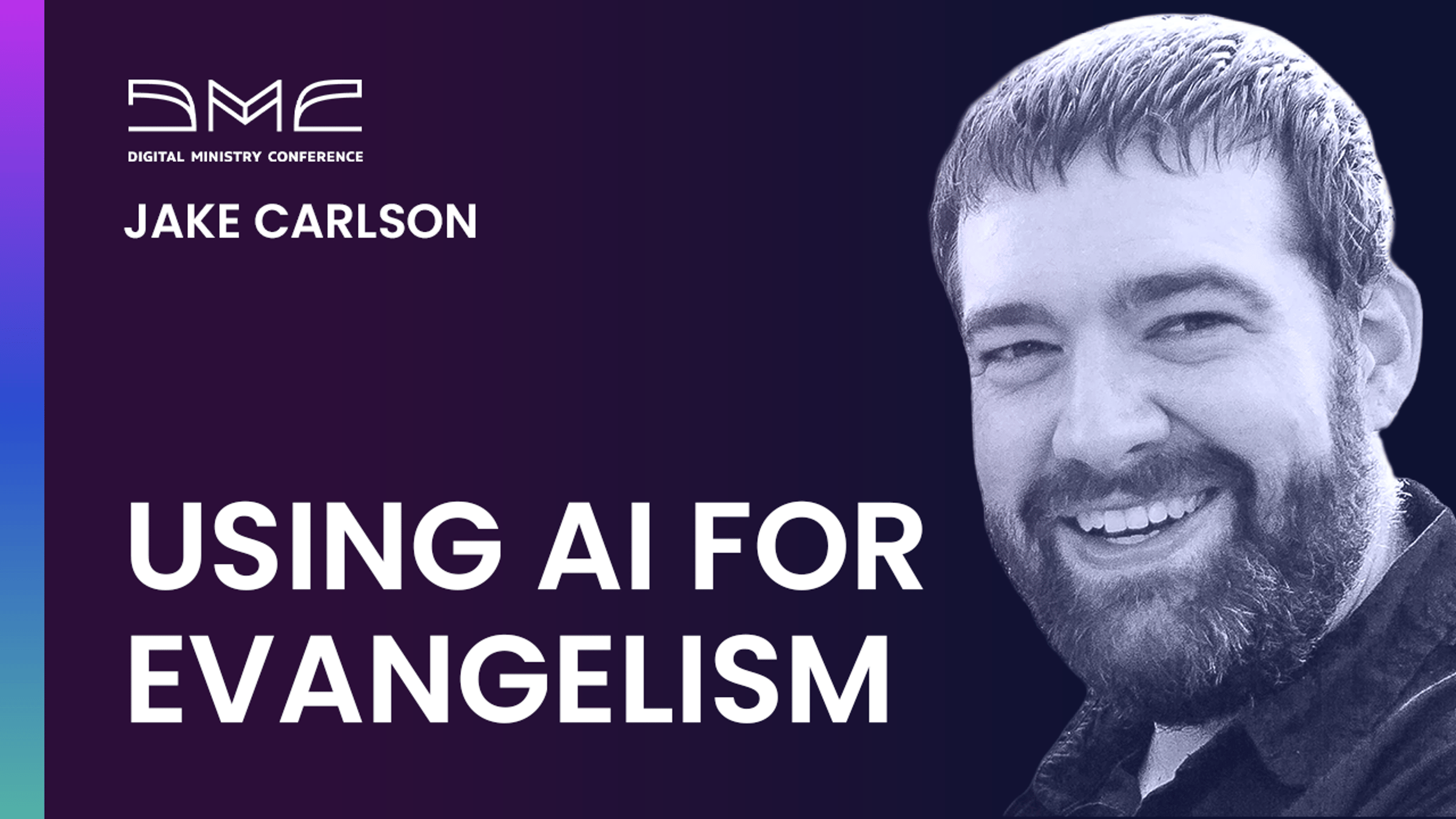
At the 2026 Digital Ministry Conference, Jake Carlson of The Apologist Project showed how conversational AI, built on biblical truth and used with discernment, is already functioning as a force multiplier for the Great Commission. In this post, we're sharing the key points from Jake's session so your ministry can see what's possible — and what steps you can take today.
How The Apologist Project Is Reaching Seekers at Scale
Jake Carlson has spent his career sitting at the intersection of technology and mission, and his DMC session brought that unique perspective to life. Below are the standout takeaways from his presentation that have direct implications for how your ministry thinks about digital outreach.
1. Over two-thirds of the world's population is online. Jake opened with this foundational reality: if your ministry isn't engaging seekers in digital spaces, you're leaving the majority of the world's population unreached. Digital presence isn't a marketing tactic — it's a mission imperative.
2. The Apologist Project's conversational AI supports up to 192 languages, covering approximately 99% of the globe. Jake shared that language support is one of the most powerful aspects of their platform. Reaching someone in their heart language — the language they think and feel in — dramatically increases the depth of a gospel conversation.
3. Their AI platform is currently processing approximately 140,000 prompts per month, and growing exponentially. What started as a small-scale experiment has scaled to the point where, in Jake's words, "somebody's using our conversational AI every 20 seconds of every day." This is real-world traction, not a prototype.
4. Got Questions — one of the most trusted Christian apologetics organizations online — has partnered with The Apologist Project and called it "the best Bible Q&A chatbot in existence." Shea Houdmann, President of Got Questions, provided this endorsement based on the platform's consistent delivery of biblically grounded answers. Got Questions' chatbot at gotquestions.chat was among the most-used on the platform — without any advertising.
5. The platform uses clinical frameworks (including a five-point suicidal ideation scale) to identify where a user is emotionally and spiritually, and then serves targeted, appropriate resources. Jake described how the AI evaluates conversations in real time, surfacing hotlines for those in crisis, and spiritual resources mapped to where a person is on their faith journey — using tools like the Engel Scale to assess spiritual readiness.
The Ministry Implications You Need to Understand
For ministry leaders, the tension around AI and evangelism is real. There's genuine concern about whether technology belongs anywhere near the sacred work of sharing the gospel. Jake addressed this directly — and the evidence he presented makes a compelling case that, when grounded in biblical truth and used with discernment, AI doesn't replace human connection. It extends it.
Here's what the insights from this session mean for how you lead:
Your reach has a ceiling — AI can raise it. Even the most well-staffed ministry has limits on when, where, and how many people it can engage at once. Conversational AI doesn't replace your team; it fills the gaps — the 2 a.m. questions, the seekers in countries where no missionary can travel, the person who isn't ready to talk to a human but is searching for answers online.
People open up to AI in ways they don't with humans. Jake noted that users in closed countries, especially, are more willing to ask vulnerable questions when they feel safe from judgment and surveillance. This isn't a liability — it's an opportunity to meet people in their most honest moments and point them toward truth.
Biblical grounding is the non-negotiable foundation. The reason this works isn't the technology — it's the content. The Apologist Project's platform doesn't just pull from any source; it's curated with trusted apologetics content from partners like Got Questions, Bible translations, and contextually appropriate resources. The AI is only as trustworthy as what it's built on.
Contextualization multiplies impact. Jake shared how their Muslim-serving chatbot incorporates Quranic verses alongside biblical truth, allowing a Muslim seeker to find familiar ground before being gently guided toward the gospel. This is the kind of personalized, culturally sensitive outreach that most ministries could never scale manually.
Practical Next Steps for Your Ministry
Knowing what's possible is only valuable if it leads to action. Jake's session made the case clearly — AI-assisted evangelism is no longer experimental, it's operational.
Here are four concrete steps your ministry can take to move from awareness to engagement.
1. Assess where your ministry stands on AI-assisted outreach. Jake asked his audience to raise their hands based on where they were in their AI journey — from "haven't considered it" to "actively using AI in external communications." Honest self-assessment is the starting point. Where does your ministry fall? If AI use is still entirely internal, it's time to ask: what would it look like to engage the people we serve?
2. Explore The Apologist Project as a potential ministry partner. If your ministry has an external-facing audience — seekers, curious visitors, people exploring faith — consider reaching out to The Apologist Project directly to explore how their conversational AI platform could integrate with your digital ministry. You can learn more at https://apologistproject.org/.
3. Visit gotquestions.chat to see a live example of biblically grounded conversational AI. Before building your own strategy, experience what's already working. Got Questions has a functioning chatbot at gotquestions.chat that demonstrates how AI can handle complex spiritual questions with accuracy and care.
4. Ensure any AI tool your ministry uses is built on curated, theologically vetted content. The biggest risk with AI for evangelism isn't the technology — it's the source material. Before adopting any AI-powered outreach tool, ask: what content is this AI drawing from? Who vetted it theologically? If you don't have a clear answer, keep looking.
The Great Commission Calls for Every Tool Available
The Great Commission has always required going to where people are. Today, more than two-thirds of the world is online — searching, questioning, looking for hope. AI, used with discernment and grounded in biblical truth, gives your ministry the ability to show up in those moments in ways that were never before possible.
Jake Carlson's session was a reminder that this isn't theoretical. It's happening. Ministries are already reaching seekers in closed countries, in 192 languages, every 20 seconds of every day. The question isn't whether AI can be used for evangelism — it's whether your ministry will steward that opportunity.
You don't have to figure this out alone. The ministry community is growing together in this, and Five Q is here to help you navigate what responsible, mission-aligned AI adoption looks like for your organization.
Ready to move from experimentation to impact? Learn more about Launch AI — Five Q's 90-day program built to help ministries implement AI with strategy, governance, and measurable results.
Rachel Slininger is a Sr. Account Executive & Marketing Specialist at Five Q, where she helps ministries and faith-based nonprofits multiply their digital impact. This article was developed using AI writing tools guided by her research and editorial framework. The ideas, arguments, and positions are hers. She has directed, edited, and approved this article before publishing.