How One Card Put AI in Every Hand | Don Barger
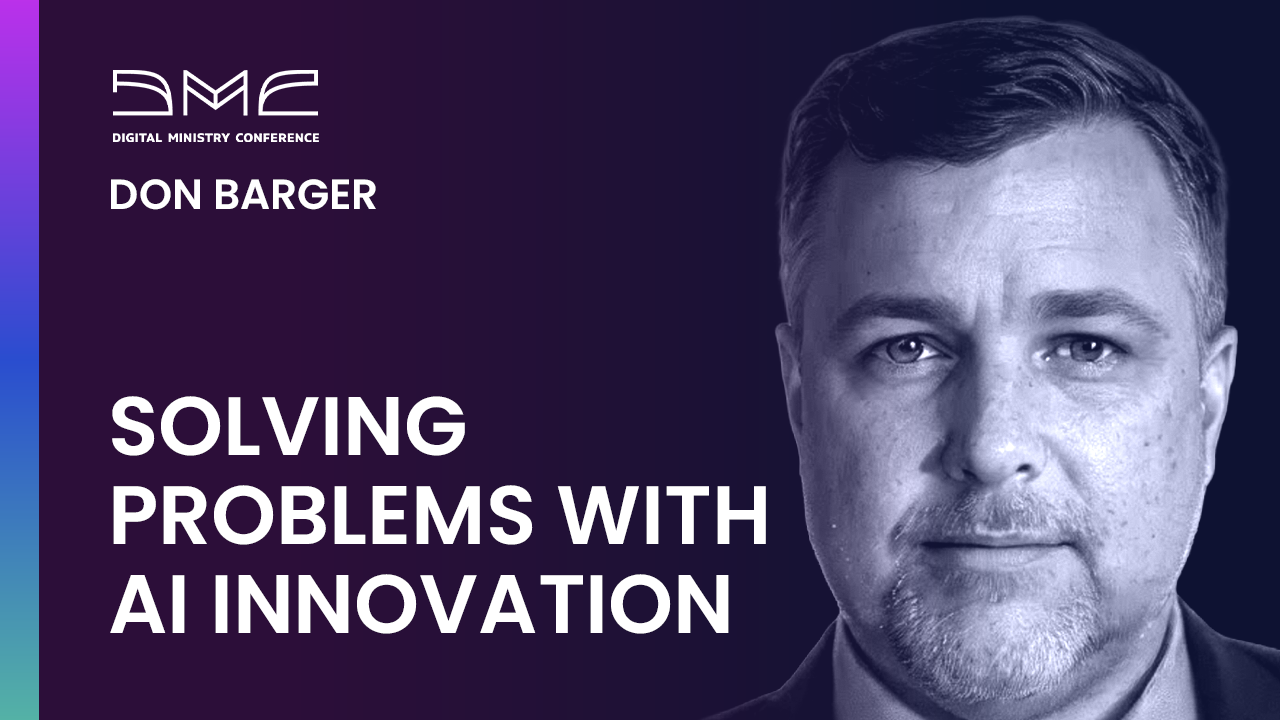
What if a hotel key card could spark a global gospel movement — and teach your organization everything it needs to know about adopting AI?
At the 2026 Digital Ministry Conference, Don Barger, Director of Innovation and Artificial Intelligence at the International Mission Board (IMB), shared the story of how one small, tangible idea helped bring a risk-averse, 81-year-old organization from AI skepticism to full-scale implementation. If your ministry is struggling to get buy-in on AI — or just doesn't know where to start — Don's framework for driving innovation from the inside out offers a clear and proven path forward.
5 Lessons from the IMB's Journey to AI Adoption
Ministry leaders across the country are wrestling with the same challenge: how do you get an entire organization to embrace AI — especially when there's fear, skepticism, and institutional resistance standing in the way? Don Barger has been doing exactly that at the IMB for the past several years, and his session at DMC 2026 was full of honest, hard-won lessons.
Here are the key points he shared:
1. Easy wins build unstoppable momentum. Don shared that the IMB's first AI pilots weren't massive, mission-critical deployments. They were small, practical experiments in three areas: translation of internal communications, a digital responder chatbot, and processing donor-related information in the ministry advancement department. These quick wins gave skeptics something tangible to see — and believe in. According to Don's session, those early wins were critical to getting the organization moving in the right direction.
2. A physical NFC card sent 25,000 people to an AI chatbot. Don distributed a few hundred programmed NFC cards (similar to hotel key cards) at a single event. Within days, 25,000 people had tapped them and engaged with the IMB's AI chatbot. The idea had started simply — Don noticed how people kept hotel key cards and wondered if the same tactile technology could be used to share the gospel. That small observation led to a tool now used by more than 400,000 users worldwide in multiple languages.
3. FaithBot started as a responder filter — and became a global evangelism tool. The IMB runs digital engagement with tens of thousands of online conversations globally each year. The original need was simply to triage conversations — routing genuine seekers to human responders while filtering out disruptive inputs. What started as a back-end operations tool evolved into a full evangelism resource being used organically across the globe.
4. Leadership alignment is the non-negotiable foundation. Don was explicit: without the backing of the IMB's President and EVP, none of it would have happened. The IMB took the entire senior leadership team through an MIT Sloan course on business applications for AI — six weeks of roughly 10 hours per week. The result? Executive-level champions who could make informed decisions and back bold implementation. "If you don't have that," Don said, "it's actually probably impossible to bring about change."
5. An AI belief statement must come before the tools. One of the most important steps the IMB took was establishing a formal belief statement on AI before building a single tool. Don's point was simple: just because you can do something with AI doesn't mean you should. Without defined guardrails, organizations end up on a slippery slope. For IMB, that belief statement included a clear boundary: AI should not provide soul care. "Soul care is provided by souls, not algorithms," Don said. That clarity gave the organization confidence and protected the integrity of its work.
The People Problem Most Ministry Leaders Don't See Coming
Don Barger's story is a masterclass in organizational change management — and it maps directly onto what most ministry leaders face today. The principles here are universal, whether you lead a local church, a global missions organization, or a faith-based nonprofit.
Most ministry leaders don't struggle with the tools. They struggle with the people. How do you bring along the board member who's worried about AI replacing staff? The department head who tried a chatbot two years ago and was underwhelmed? The volunteer who's convinced AI is ethically problematic?
Don's answer: make the first step so small, so tangible, and so obviously useful that resistance dissolves on contact. The hotel key card didn't ask people to rethink their theology of technology. It just said tap here — and let the results speak.
There's also a stewardship argument embedded here. The IMB is now saving substantial dollars annually on translation of internal communications and materials used overseas — all with a human in the loop. When leadership sees that AI is protecting human capacity for high-value work, the conversation shifts from "should we?" to "how quickly can we?"
Don also reminded the DMC audience that the best AI champions in an organization are often the people who were the most resistant 12 months earlier. When a skeptic becomes a believer, they become your loudest advocate. That's not a marketing strategy — it's a natural result of making innovation irresistible.
How to Find Your Ministry's "Hotel Key Card Moment"
The IMB's journey didn't start with a big strategy deck. It started with someone asking: What's the smallest thing I can do that will actually matter? Here's how to apply that same thinking in your ministry:
1. Identify your "hotel key card moment" — and execute it. Look for a low-stakes, high-visibility problem your team faces right now. It doesn't have to be glamorous. What's one manual, repetitive task that AI could handle so your people can focus on people? Build something small around that problem, put it in front of leadership, and let the results do the talking.
2. Create your AI belief statement before you build anything. Before evaluating tools or deploying anything, gather your leadership team and get aligned on what you believe about AI's role in your organization. What will you not use AI for? Where do you draw the line on automation versus human connection? Getting this on paper protects you, builds trust with your team and board, and gives you a foundation to build on. If you need help getting started, the Five Q Launch AI program is designed to walk ministry leaders through exactly this process.
3. Get your leadership team educated — not just informed. A summary email isn't enough. Don invested in taking the IMB's entire executive team through substantive AI education. You don't have to use an MIT course, but find something that gives your decision-makers enough depth to engage thoughtfully. It may feel slow at first — but leaders who understand AI make better decisions and become better sponsors.
4. Let innovation spread organically. Don didn't manage the viral spread of FaithBot. Someone at a pastor's conference shared it. That person's son showed it to a friend's family overseas. It multiplied on its own because it was easy to use, immediately valuable, and genuinely compelling. Build things that people want to share — and then get out of the way.
Any Ministry Can Do This — Here's Where to Start
Don Barger's session was one of the most honest and practical talks at DMC 2026 — not because he made it sound easy, but because he made it sound doable. The IMB is a large, risk-averse institution that has been around for 81 years. If they can move from fear to full-scale AI adoption, so can your ministry.
You don't need a perfect strategy. You need an easy win, a belief statement, and at least one person in leadership who's willing to say, "Keep pushing us forward."
You're not in this alone. The Five Q community is full of ministry leaders at every stage of this journey — and we'd love to help you find your hotel key card moment with Launch AI. Ready to stop experimenting and start multiplying?
Rachel Slininger is a Sr. Account Executive & Marketing Specialist at Five Q, where she helps ministries and faith-based nonprofits multiply their digital impact. This article was developed using AI writing tools guided by her research and editorial framework. The ideas, arguments, and positions are hers. She has directed, edited, and approved this article before publishing.