Screen and Soil
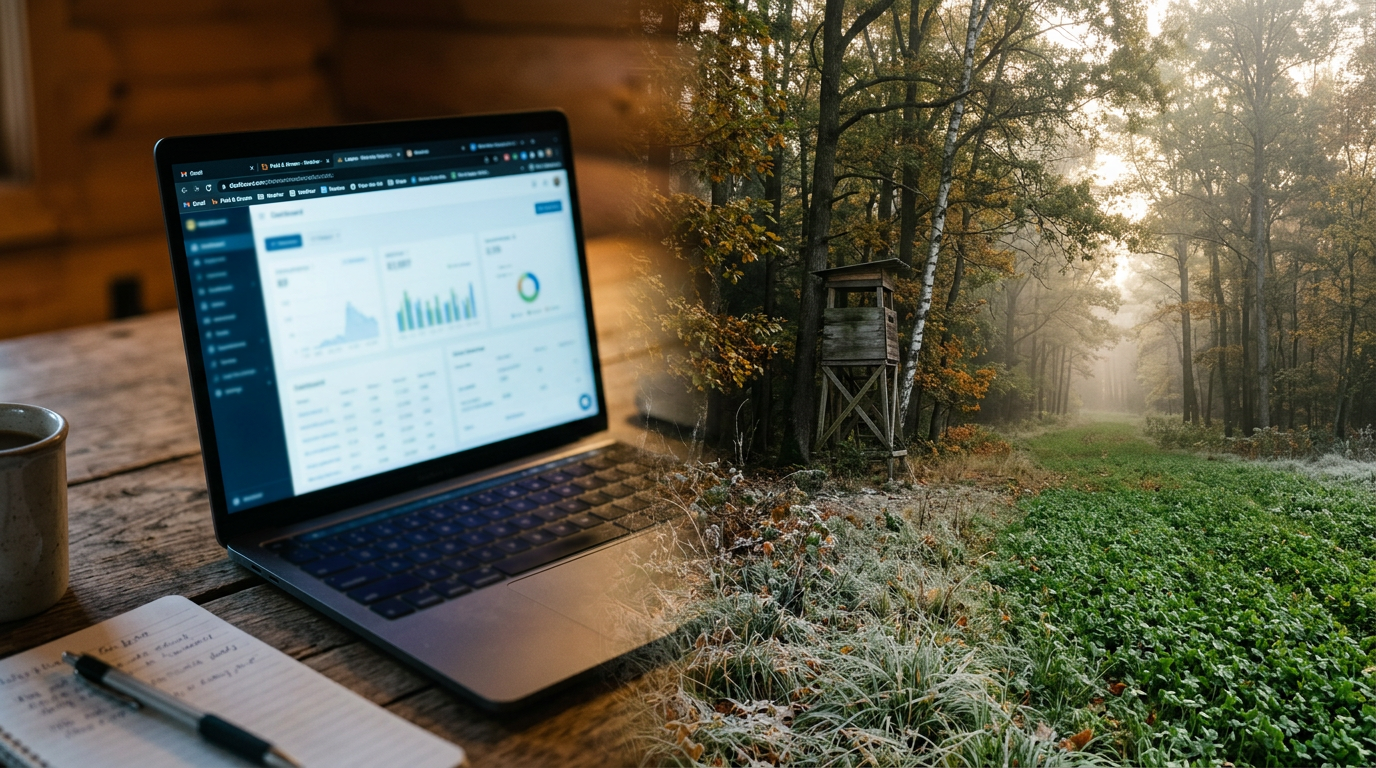
I was sitting with seven browser tabs open and an AI workflow running when I caught myself thinking about what I should be planting in this spring and fall food plots for our farm.
Not as a distraction. As a pull. The kind that doesn't ask permission.
I've been noticing a pattern over the past couple of years. The more my days fill with screens, AI tools, automation pipelines, and digital strategy — the stronger the pull towards nature in my off-hours. The timber. The soil. The food plots. The patience of a deer stand where the only task is to be alert for the next Boone and Crockett buck to walk by.
At first I thought it was just recreation. Now I think it's something else.
Nathan Named It
Nathan Chappell, Chief AI Officer at Virtuous and one of the clearest thinkers at the intersection of AI and generosity, put a name to this in a recent piece. He calls it a 'ratio'. His version looks like a wood lathe in the corner of his garage — hours spent turning a bowl for a specific person, thinking about them the whole time. Not productive. The opposite of productive. But the place, he says, where the meaning is kept.
"The more AI I use, the more I have to protect the part of life AI cannot touch, because that is where the meaning is kept."
He's describing the same pull I feel toward the timber. Different craft, same counterweight.
Nathan frames this as the survival strategy for leaders in the AI era — not opting out, but building the ratio. More AI and more of what AI cannot touch, held together. He's not arguing for retreat. He's arguing for a deliberate discipline that keeps you human enough to do the work.
That framing landed for me because it names what I've been experiencing and had not yet written about it.
What the Soil Knows
I run a digital agency. We implement AI tools, build automated workflows, and help ministry clients be effective without losing what makes their work human. I believe in this. I think the sector cannot afford to sit out at this moment.
And I also know that the version of me who can actually do that work — who can hold the tension between human-first and AI-empowered without collapsing it — shows up most reliably after I've been somewhere without a cell signal.
There's something the timber teaches that the screen can't replicate. A food plot doesn't care about your sprint. It grows on its own schedule, in its own time, and if you try to rush it, you get nothing. The hunt requires a kind of presence that has no analog in productivity software — you either show up fully or you go home empty.
That isn't a metaphor for leadership. It is leadership. Read the sign, choose the right tree for your stand, wait for the right moment, and act when it comes. The leaders I most respect have some version of this practice. The ones who've lost it tend to be loud, fast, and fragile.
What Gets Crowded Out First
The thing AI pressure crowds out first isn't rest. It's presence.
You can stay rested and still lose the capacity to sit across from someone without mentally composing your next task. You can take vacations and still return having never fully left. Ministry leaders know this especially — the pastoral impulse doesn't punch out, which means the depletion is quiet and cumulative.
What the soil gives back is actual presence. Presence as a byproduct of doing something with your hands that demands your full attention or fails. You can't half-engage with a food plot and expect it to produce. You can't half-engage with a donor relationship and expect it to hold.
The counterbalance isn't separate from the work. It's what makes the work possible.
There's a word for this that ministry leaders know better than most: Sabbath. Not as a rule to observe but as a rhythm to inhabit. The counterweight was built into the week by design — not because rest is the reward for productivity but because presence is the precondition for it. You cannot give what you haven't received. You cannot lead from a well you've stopped filling.
The further I drift from that rhythm, the more I notice it in the work. Meetings where I'm physically present but somewhere else. Conversations where I'm listening for the pause instead of the person. The soil pulls me back. The deer stand forces stillness.
The Counterweight is Not Optional
Nathan ends his piece with a phrase worth carrying: "Plant accordingly."
I've been planting — literally — and I think he's right about the larger picture too. The leaders and organizations that protect their own capacity for presence while building their AI muscle are the ones who will be worth something to the people arriving. You cannot offer what the pace has already taken from you.
The food plot will be ready when it's ready. The timber doesn't rush. And the longer I sit in a deer stand with nothing to optimize, the more clearly I can think about the things I'm actually building.
That's the ratio. Protect it.
Find your counterweight.
Hat tip to Nathan Chappell, whose piece "Community Is a Growth Industry" published on LinkedIn on May 26, 2026, sparked this reflection. He is Chief AI Officer at Virtuous and co-author of Nonprofit AI and The Generosity Crisis. Worth reading in full.
Chad Williams is the CEO & Founder of Five Q, a human-first, AI-empowered digital agency delivering mission-driven growth to ministries and faith-based nonprofits. This article was developed using AI writing tools our team has built with my voice, research, and editorial framework. The ideas, arguments, and positions are mine. I have directed, edited, and approved this article before publishing. At Five Q, we believe in a human-first, AI-empowered approach to AI. If you would like to learn more, just ask.