Why We Chose Claude — and the Research Behind It
We have been working with ministries, helping them roll out specific AI policies, practices, and platforms as a part of our LaunchAI Service. Recently, our team did significant research to help refine our top platform recommendations.
That research confirmed what we had already been moving toward—and gave us the data to say it clearly: we use Claude for most ministry AI deployments, and it is the platform we run our own operations on.
Here is why.
Why Claude Won Our Evaluation
The first thing the research surfaced is that the top three AI models — Claude, ChatGPT, and Gemini — score identically on the Artificial Analysis Intelligence Index. At the frontier, raw intelligence is effectively a tie. That meant the decision wasn't about which model is "smarter." It was about which platform would actually fit inside a ministry's daily operations.
On that question, Claude came out ahead in the ways that matter most for the organizations we serve.
Claude leads the instruction following. The LMSYS Chatbot Arena — which aggregates over 5.7 million blind human preference votes across 339 models — rates Claude Opus 4.7 at the top overall, with specific notes on "best prose rhythm, tone, and subtext." For a ministry producing donor communications, grant narratives, and leadership content, that is not a small thing.
Claude has the lowest hallucination rate on the benchmarks most relevant to document-grounded work. On AA-Omniscience, Claude Opus 4.7 hallucinates at 36% — compared to GPT 5.5 at 86%. When an AI is working from your source material, accuracy matters more than speed or novelty.
Claude's security posture is sound. Our research rates its connector marketplace as low risk — curated, reviewed, stable. One of the other platforms we evaluated had a documented supply chain attack in February 2026. For a ministry, trust in the tools is not abstract — it is the whole conversation.
And we have already built our operational library on Claude. Our skill library — the encoded workflows and frameworks Five Q uses every day — is built in a file format native to Claude. That means every ministry that comes through LaunchAI gets a platform our team already knows in depth and can support without guesswork.
The Five Areas We Evaluated
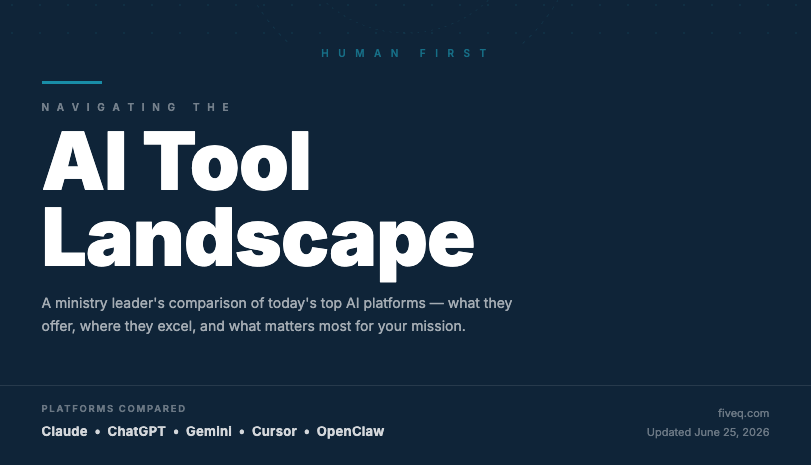
We compared Claude, ChatGPT, Gemini, Cursor, and OpenClaw across five major capability layers. Here is what each one means in practice for a ministry deployment.
Context containers are how you give the AI a persistent role inside your organization. Claude calls them Projects. You can upload knowledge files, share them across your team, and carry consistent context from session to session. For a ministry, this is how you encode your voice, your theology, your audience standards, and your brand — so the AI works from your foundation, not a generic one.
Skills are reusable workflow instructions that sit on top of any context container. Think of them as specialists you train once and deploy repeatedly. Our research found that Claude's skill format is the most portable across tools — version-controlled, shareable, and not locked inside a platform's UI. We build the Five Q skill library this way, and the ministries we work with can build their own on the same foundation.
Connectors are the "connecting the AI to your actual tools" layer. MCP — Model Context Protocol — has become the shared standard across all major platforms, and Claude supports it fully. For a ministry already using Slack, email, project management, or donor platforms, connectors are how the AI becomes part of your existing workflow rather than a separate tool you have to visit on purpose.
Scheduling and automation are where the most meaningful operational distinction lives. Some AI platforms generate text on a timer. Claude Cowork takes real actions — files, connected apps, calendar events — when scheduled. That is the difference between a tool that produces output and one that does work. We use this to run recurring tasks for the ministries we serve without requiring someone to manually trigger them each time.
Accuracy on your documents is the category most relevant to ministry leadership decisions. We tracked five hallucination and accuracy benchmarks. The core finding: no single model wins every test, but Claude is consistently strong on the measures that matter most for knowledge-work organizations — and every reasoning-class model struggles on long documents. That is why our LaunchAI process always includes a testing phase with your actual content before finalizing any recommendation.
The Full Research is Yours
We are sharing the complete comparison document — all eight sections, including the hallucination benchmark scores — so your team can review the data directly.
Download the Five Q Frontier Offerings Comparison →
The research covers Claude, ChatGPT, Gemini, Cursor, and OpenClaw, compiled from a full evaluation session on June 30, 2026. It includes benchmark scores, capability comparisons across all five platforms, and the operational decisions we have made for our own work and for the ministries we serve. We are updating this each month.
If you are in the middle of an AI platform decision and want to talk through what is right for your specific context, this is exactly what LaunchAI is designed for.
Start with good research.
Hat tip to Josh Kashorek for compiling this research and setting it up to be a recurring activity so we can keep the pulse on new models.
Chad Williams is the CEO & Founder of Five Q, a human-first, AI-empowered digital agency delivering mission-driven growth to ministries and faith-based nonprofits. This article was developed using AI writing tools our team has built with my voice, research, and editorial framework. The ideas, arguments, and positions are mine. I have directed, edited, and approved this article before publishing. At Five Q, we believe in a human-first, AI-empowered approach to AI. If you would like to learn more, just ask.