Why Your Donor List Is Leaving Money Behind
Your ministry is working hard to reach more people, but scattered donor data across disconnected tools means your acquisition budget is likely reaching the wrong audiences — and you may not even know it.
What if a unified tech stack and AI-powered automation could cut your cost to acquire a new donor by 20% and grow new donors by 25% — virtually overnight?
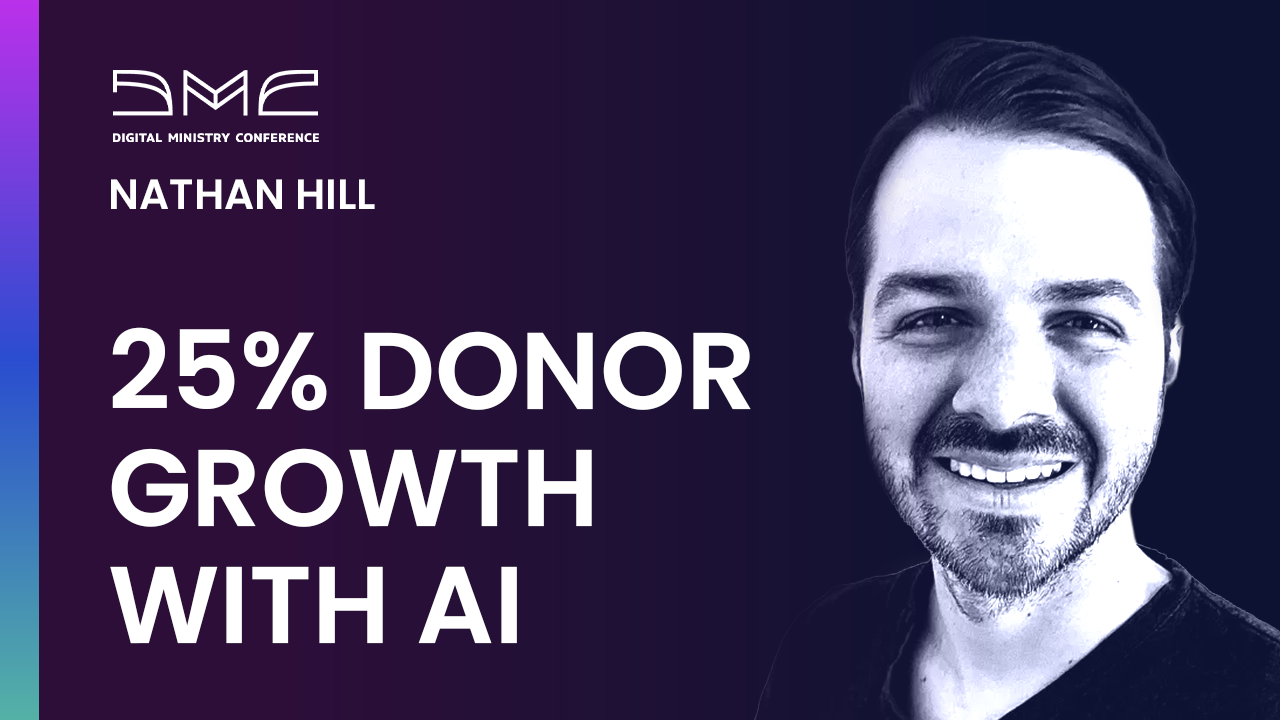
In this session from the 2026 Digital Ministry Conference, Nathan Hill, VP of Marketing at AVID, walks through exactly how Bible League Canada did it — and the practical framework any ministry fundraising team can begin applying today.
What the Data Says: The Real Cost of Siloed Donor Data
The results Bible League Canada achieved aren't an anomaly — they're what happens when a ministry stops guessing and starts letting unified, AI-powered data do the work.
Here's the data Nathan shared that makes the case.
- A first-year donor averages $81 in giving — but a second-year donor gives $214, and a third-year-plus donor gives $322 annually. Based on data from 43 ministries representing approximately $1.4 billion in annual revenue, new donor acquisition isn't primarily about revenue today — it's about compounding kingdom impact over time.
- Bible League Canada decreased their cost to acquire a new donor by 20% and grew new donors by 25% by unifying their tech stack and adding AI-powered automation through AVID.
- A sample organization on pace for $7.4 million in annual donor revenue had a three-year outlook of $7.1 million under current conditions. By investing in an acquisition growth strategy, that three-year outlook jumped to $10.5 million — a 47% increase.
- When compared to one of the most sophisticated marketing CRMs available, AVID led to a 143% increase in donor acquisition. Even best-in-class CRM tools are significantly limited in their ability to move and sync donor data across channels for acquisition targeting.
- Most ministries rely on their CRM as their primary donor data source — but critical giving history, engagement data, and transaction records live in disconnected tools. This leads to stale prospecting lists, wasted ad spend, and missed acquisition opportunities.
This Is a Stewardship Problem, Not a Tech Problem
Here's the honest reality Nathan surfaced at the Digital Ministry Conference: most ministries are spending money to acquire new donors using incomplete information. Your CRM holds some data. Your donation platform holds more. Your email tool holds engagement history. But when those systems don't talk to each other, the list you hand to a platform like Meta for lookalike audience targeting is built on a fraction of what you actually know about your donors — and that gap is costing you.
The deeper issue is stewardship. Every dollar spent on acquisition targeting the wrong person is a dollar not working for the mission. And when you understand that a donor acquired today is worth four times as much in year three, the urgency of getting acquisition right becomes clear. This isn't a tech problem — it's a mission problem.
The good news? Bible League Canada's results show this is a solvable one. Bringing all donor data under one roof and automating the process of refreshing audiences and suppressing existing donors from acquisition campaigns are not incremental improvements — they're foundational shifts that directly multiply kingdom impact.
Three Steps to Stop Wasting Your Acquisition Budget
The good news is that fixing your acquisition strategy doesn't require starting from scratch. Nathan outlined a straightforward path any ministry fundraising team can begin walking today — no matter where you are in your tech journey.
1. Audit where your donor data actually lives. Before you can unify your tech stack, you need a clear picture of what data exists and where. Map out your CRM, donation platform, email tool, SMS platform, and any other system that holds donor or supporter information. This is step zero — and most teams skip it.
2. Identify the gaps between your tools and your targeting. Look at your current acquisition targeting process: What data are you actually sending to Meta or your advertising platform? Is it pulling from only your CRM? If so, you're missing transaction data, engagement history, and more. The goal is a "golden record" — a complete, unified view of your donor.
3. Prioritize automation for both audience targeting AND suppression. It's not enough to build a better list once. Nathan emphasized that the speed at which your audiences are refreshed is a direct driver of acquisition effectiveness. Equally important: automate the removal of existing donors from acquisition campaigns so you're not spending money to re-acquire people already in your fold. Both pieces compound over time.
Stop Guessing. Start Growing.
The ministries winning at donor acquisition aren't necessarily the ones with the biggest budgets — they're the ones stewarding their data and their dollars with the most precision.
Nathan Hill's session at DMC 2026 is a practical, proven reminder that the tools exist today to stop guessing and start growing. You don't have to overhaul everything overnight. Start with a clear-eyed look at where your data lives, close the gaps, and let automation do the heavy lifting so your team can stay focused on what matters most: advancing the mission.
You're not in this alone. The digital ministry community is figuring this out together — and resources like the Ministry at Scale podcast exist to bring these conversations directly to you.
👉 Listen to Nathan Hill's full DMC session here: From Siloed Data to 25% Donor Growth
Rachel Slininger is a Sr. Account Executive & Marketing Specialist at Five Q, where she helps ministries and faith-based nonprofits multiply their digital impact. This article was developed using AI writing tools guided by her research and editorial framework. The ideas, arguments, and positions are hers. She has directed, edited, and approved this article before publishing.