Big Tech, Bold Faith: Lessons for Leaders
The Gospel Is Advancing Where You Least Expect It
Most ministry leaders assume the Gospel is advancing in churches, on mission fields, and through digital ministry platforms. What if God is also at work — quietly, powerfully — inside the walls of the world's most influential technology companies?
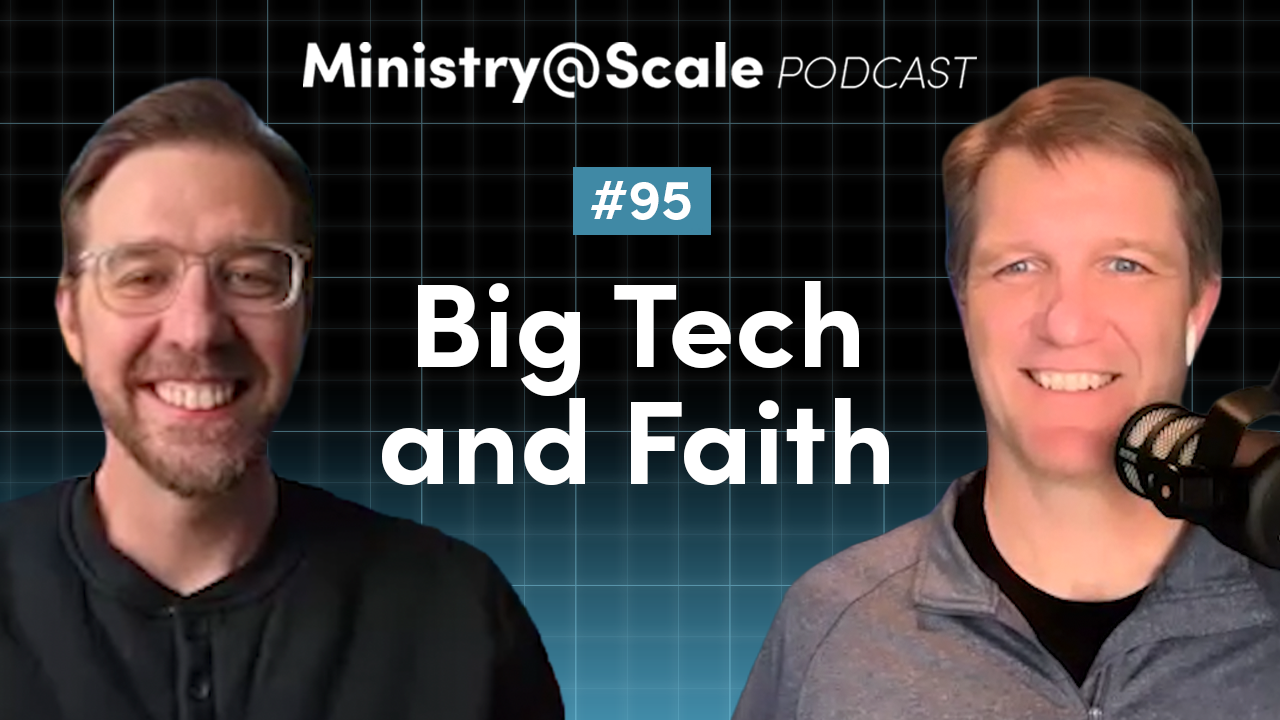
Rich Robison has spent 25 years in tech, most recently as a leader at Meta, where he discovered that his cubicle was actually a mission field. In his Ministry at Scale Podcast Episode and his 2026 Digital Ministry Conference session "How People of Faith are Making an Impact in Tech", Rich shares what faithfully leading in Big Tech looks like — and why his story has profound implications for every ministry leader who wants to multiply impact beyond their organization's walls.
What Rich Found Inside the World's Biggest Tech Companies
Rich didn't just survive in Big Tech as a believer — he found a Kingdom already at work there. Here's what he discovered.
1. Christian communities are thriving inside Big Tech — across five continents. Rich leads the Global Christian Leadership Group at Meta, overseeing Christian communities on five continents. During the 2022–2023 tech industry layoffs, Christian groups across multiple major tech companies came together to support one another, pray, and reground their foundation in what truly lasts — not their companies.
2. Facebook launched a prayer feature in 2021 in response to explosive growth of Christian communities on its platform. During COVID, when churches couldn't meet in person, Facebook Live and YouTube became major support channels for Christian communities. Facebook took notice and rolled out a dedicated prayer feature allowing group members to post prayer requests and mark when they'd prayed for someone.
3. Technology can reach places missionaries cannot. Rich stated it plainly in his DMC session: "Technology can go places that missionaries can't. The Great Commission happens in the 21st century through these giant technology platforms." If God is using Big Tech to advance His Kingdom, digital ministry isn't a supplemental channel — it's a primary one.
4. Being publicly known as a Christian at work creates a safe space for others — hiding your faith is a missed opportunity. Rich spent most of his career holding secret lunchtime Bible studies, afraid of how faith would affect his career. But in his current organization and role, he chose differently. As he shared in his DMC session, his boss, team, and business partners all know he's a Christian — and that openness has created a space where coworkers proactively come to him with their own spiritual questions.
5. AI is powerful, but it has no spiritual discernment — it only knows what humans have written. Rich, who studied AI in the 1990s as part of his undergraduate work, offered a grounding perspective in Episode #95: AI synthesizes the entire body of human knowledge on the internet, but it carries no lived experience, no hope, and no faith. "Human knowledge is good, but human knowledge is limited," he said. For ministry leaders adopting AI tools, this is a critical reminder that human discernment — rooted in your mission — must guide every output.
Why This Should Change How You Think About Reach
Rich's story connects directly to something every ministry leader wrestles with: how do we extend our mission's reach beyond the walls of our organization? The typical answer involves digital marketing, email campaigns, and social content strategy — and those things matter enormously. But Rich's story reveals something deeper. The people who sit in your congregation, volunteer on weekends, and donate to your ministry are themselves mission fields in the marketplace. Are you equipping and encouraging them to see it that way?
For the executive leader stewarding limited resources toward maximum Kingdom impact, this reframes a critical question. It's not only, "How do we grow our digital reach?" It's also, "Are we equipping our community to carry the mission into the spaces they already occupy every day?"
Rich's perspective on AI is equally important for ministry leaders navigating AI adoption. The temptation — especially for stretched teams — is to trust AI outputs at face value. His reminder that AI only knows what humans have written, without any spiritual discernment, underscores why human oversight grounded in Scripture must remain at the center of every AI strategy your ministry pursues.
Finally, his insight on identity is a challenge for all of us: he spent years worried about how people would see him if they found out he was a Christian, when the real question should have been — When people find out I'm a Christian, can I represent Jesus well? That's a question every ministry leader and every person they disciple carries into the workplace.
Three Ways to Put This Into Practice
1. Share Rich's story with the marketplace members in your community. Forward the podcast episode or DMC session video to your donors, volunteers, and community members who work in corporate or tech environments. A brief email or social post — "Your job is your mission field — listen to this" — can be the nudge someone needs to stop compartmentalizing their faith at work.
2. Audit whether your discipleship strategy prepares people for Monday as much as Sunday. Set aside 30 minutes this week and ask honestly: Does our programming equip people to live out their faith in the workplace? If the answer is no, that's a content and programming gap worth addressing. Your ministry's true reach extends as far as the people in your community extend their own faith into their daily lives.
3. Make prayer and spiritual dialogue a built-in feature of your online community, not an afterthought. Rich's account of Facebook's 2021 prayer feature shows that when platforms create space for spiritual community, people use it deeply. Whether your community gathers on a Facebook Group, a church app, or your own platform, ensure prayer, encouragement, and spiritual conversation are designed in — not bolted on.
Your People Are Already in the Field
Rich Robison walked into a company he didn't want to work for — one he didn't even have an account with — and God turned it into one of the most fruitful mission fields of his life. That's not just an inspiring personal story. It's a reminder that the Kingdom is advancing in places we often overlook, and that the people in your ministry community are the greatest multipliers of that mission everywhere they go.
You don't have to reach every corner of the world alone. The people you disciple, equip, and encourage today are your most powerful strategy. Together, we can build ministries that don't just grow online — but grow the Kingdom through every life we touch.
Rachel Slininger is a Sr. Account Executive & Marketing Specialist at Five Q, where she helps ministries and faith-based nonprofits multiply their digital impact. This article was developed using AI writing tools guided by her research and editorial framework. The ideas, arguments, and positions are hers. She has directed, edited, and approved this article before publishing.