From Reach to Response: Why Engagement is the New Metric for Ministry Growth

Here is a number that feels like success: 10,000 impressions on last week's social post. Here is a number that actually measures ministry: 14 people clicked through, 3 filled out a prayer request, and 1 scheduled a call with a counselor.
Those are not the same thing. But for years, most ministry digital strategies have been built around the first number and almost entirely blind to the second.
That is changing. And if your organization hasn't made the shift yet, 2026 is the year to start.
The Reach Trap
Reach feels like impact. When a post gets shared widely, when a video view count climbs, when your follower count hits a new milestone — these things feel like momentum. And in some contexts, they are.
But reach is a broadcast metric. It tells you how far your message traveled, not whether it landed. For ministries whose mission is discipleship, transformation, and relationship — reach alone is one of the least useful numbers you can track.
The research bears this out. A 2025 Subsplash study found that 70% of people now engage with a church or ministry online before ever visiting in person. That is a remarkable opportunity. But it only becomes an opportunity if your digital presence is built to move people forward — not just expose them to your brand.
The question is not: how many people saw us this week? The question is: how many people took a meaningful next step?
"Go therefore and make disciples of all nations, baptizing them in the name of the Father and of the Son and of the Holy Spirit, teaching them to observe all that I have commanded you." — Matthew 28:19-20
The Great Commission is a movement metric, not a broadcast metric. "Go and make" implies response, transformation, and ongoing relationship. Discipleship happens in the space between awareness and action.
What "Engagement" Actually Means for Ministries
Engagement has become a buzzword so overused it has nearly lost meaning. Likes and comments technically count as engagement. But a prayer emoji under a post does not make a disciple.
For faith-based organizations, meaningful engagement looks like this:
- A first-time website visitor who clicks "Learn More" and fills out a connect form
- A donor who responds to a stewardship email by upgrading to a monthly gift
- A newsletter reader who forwards a devotional to a friend and includes a personal note
- Someone in spiritual crisis who finds your resource page through a Google search and reaches out for prayer
- A longtime supporter who shares your content because it moved them — not because you asked
None of those show up in a reach report. All of them represent someone taking a meaningful step closer to your mission.
Engagement is defined by response, not reach. Every post, email, and page on your site should lead somewhere.
Five Metrics Worth Tracking Instead
Shifting from reach to response requires a different dashboard. Here are five metrics that actually tell you whether your digital strategy is working:
1. Next-Step Conversion Rate
What percentage of visitors take a meaningful action on your website — signing up for email, submitting a prayer request, making a gift, or registering for an event? If people are visiting and leaving without doing anything, your site may be reaching them without actually engaging them.
2. Email Engagement Rate
Opens matter less than clicks. A 30% open rate with a 1% click rate is less valuable than a 20% open rate with a 6% click rate. And the channel is worth taking seriously: Nonprofit Tech for Good reported that 33% of donors say email is the tool that most inspires them to give — outranking social media, websites, and print. Your email list is one of your most direct channels to the people who already care — measure whether it's moving them to act.
3. Recurring Donor Retention Rate
A recent Virtuous study shows monthly donors retain at 80–90% annually, compared to 40–45% for one-time donors. If you're measuring total gifts but not tracking how many of your recurring donors are still giving 12 months later, you're missing one of the clearest signals of whether your communication and community are working.
4. Return Visitor Rate
A first-time website visitor represents awareness. A return visitor represents interest. Someone who visits your site three or more times in a month is telling you something important. Are you tracking it? Are you responding to it with personalized content or timely outreach?
5. Discipleship Pathway Progression
This is the hardest to measure and the most important. How many people who first engaged with your ministry digitally are now giving, serving, attending, or growing? This requires connecting your digital data to your CRM — but the ministries that do it are the ones building sustainable, mission-aligned growth.
Building a Digital Discipleship Pathway
The shift from reach to response does not happen by accident. It requires intentional architecture: knowing what you want someone to do when they first encounter your organization online, and then designing every touchpoint to move them toward that action.
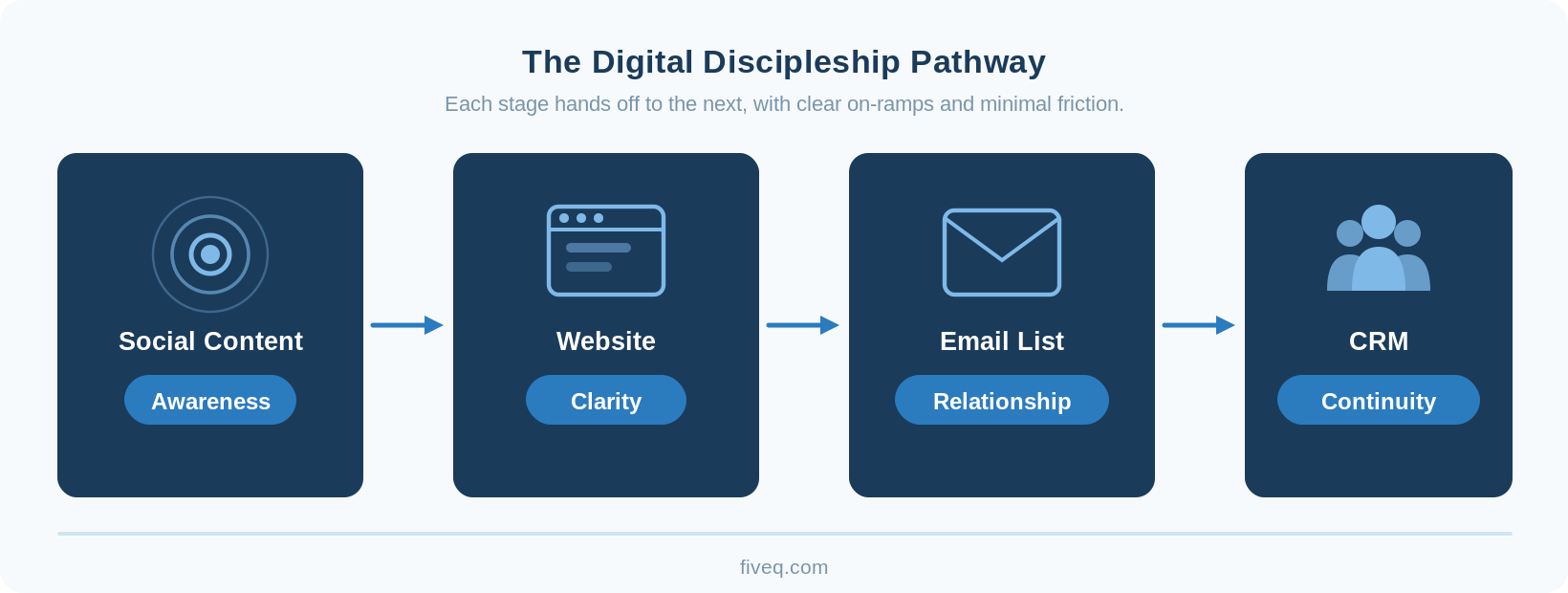
Think of it like this: your social content creates awareness. Your website creates clarity. Your email list creates relationship. Your CRM creates continuity. Each one should hand off to the next, with clear on-ramps and minimal friction.
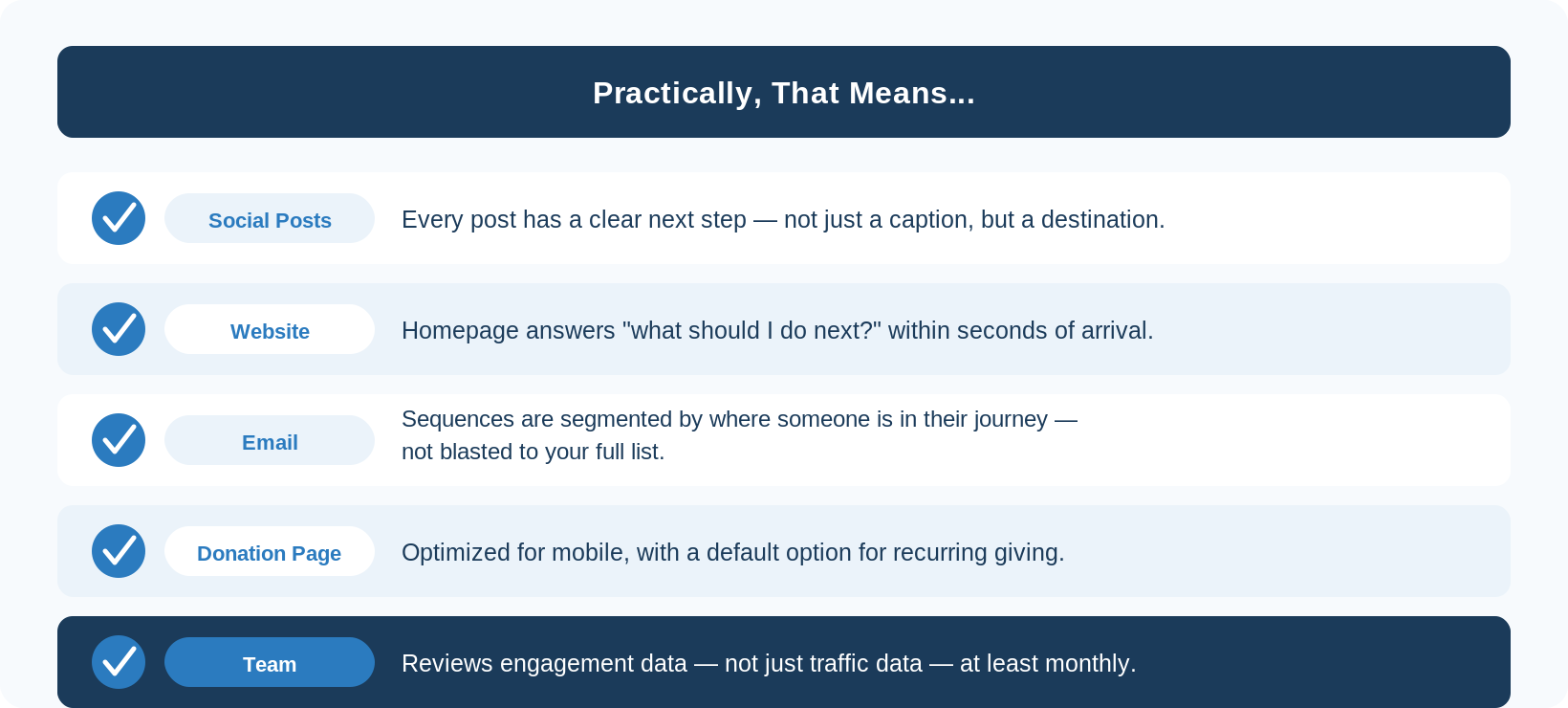
The goal is not to automate your ministry. The goal is to use digital tools to do the awareness, clarity, and connection work at scale — so your team can focus their time and energy on the relational, irreplaceable work of walking with people.
At Five Q, we think about this through the lens of Mission Driven Growth — a framework built around four priorities kept in their proper order: Mission, Impact, Fund, and Scale. The digital discipleship pathway described above is not just a marketing strategy; it is a way of ensuring that every stage of your digital presence is serving your mission, producing measurable impact, and building the kind of audience that can sustain and fund your next stage of growth.
A Practical Challenge for This Week
Pull up your most recent social post or email send. What was the explicit next step? Where did you ask people to go, and how many of them went there?
If you can't answer that question, you don't have a content problem — you have a measurement problem. And measurement problems are solvable.
Start with one channel. Define one meaningful next step. Track what happens when you make it clear, make it easy, and make it personal. You may be surprised how much is already working — and how much more is possible when you start measuring what matters.
If you want to go deeper, the Ministry Growth Assessment is a fast, practical diagnostic — less than 20 questions — that compares the work your ministry is producing to the reach and impact you are actually seeing. It will surface where things are out of balance and give you a clearer picture of where to focus next.
Ready to see where your ministry stands? Take the free Ministry Growth Assessment and get a clearer picture of where your mission, impact, and digital strategy are aligned — and where they're not.
Sources:
1. Subsplash. "The Future of Faith: 100 Church Tech Trends for Pastors in 2026."
2. Virtuous. "Faith-Based Nonprofits: Track the 7 Most Important Fundraising Shifts for 2026."
3. Funding for Good. "Nonprofit Fundraising Trends for 2026."
4. Nonprofit Tech for Good. "2026 Email Marketing Statistics for Nonprofits."
Rachel Slininger is a Sr. Account Executive & Marketing Specialist at Five Q, where she helps ministries and faith-based nonprofits multiply their digital impact. This article was developed using AI writing tools guided by her research and editorial framework. The ideas, arguments, and positions are hers. She has directed, edited, and approved this article before publishing.